Review
Classroom Storage Ideas for Teachers: Boxes, Trays and Resource Storage
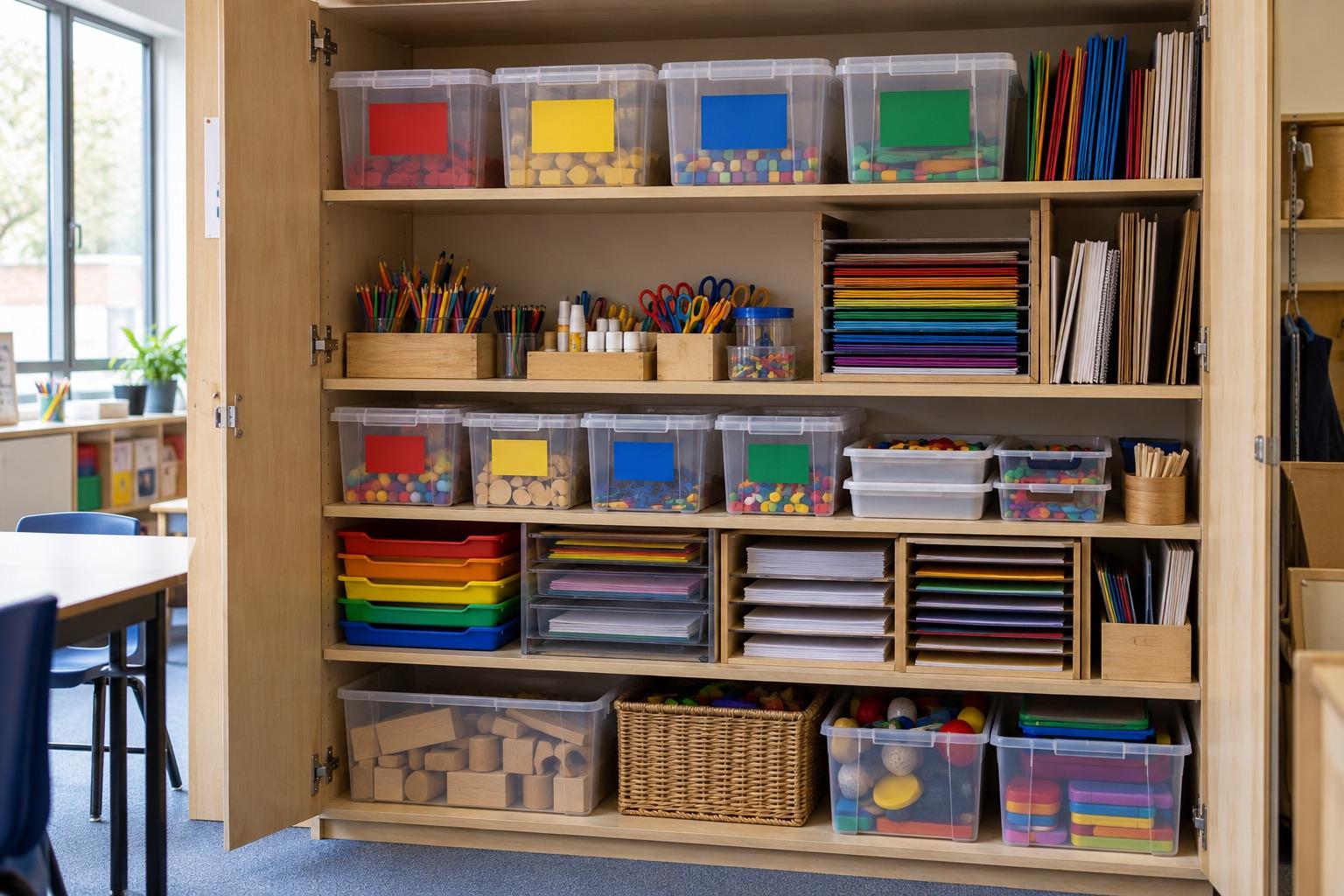
A storage box only helps if it fits the shelf, contents and person who has to carry it. Measure first and label by lesson use, not by vague category.
Quick verdict
For small, ready-to-grab resource sets, clear lidded boxes around A4 size are a flexible starting point. Use larger boxes for bulk or archive storage only after checking shelf space, filled weight and who will move them.
- Best for
- Teachers and departments organising reusable class materials
- Price guidance
- Compare pack quantity and internal dimensions; storage bundles and prices change
Researched evaluation — not presented as hands-on testing of every product.
Disclosure: Some links may be affiliate or sponsored links. If you buy through them, TeacherGuide may earn a commission. This never changes our rankings or verdicts. See our affiliate disclosure and review policy.
Paid Amazon links: TeacherGuide may earn a commission if you buy through these links.
What we liked
- Connects box size to actual classroom contents
- Includes checks for shelf fit and safe lifting
- Encourages reuse of existing school storage
What we disliked
- No physical load or durability tests were conducted
- Lidded boxes can add clutter if every resource is kept
Who should buy
- Departments setting up labelled subject or intervention kits
- Teachers who need to protect resources from dust between terms
Who should avoid
- Anyone without permission or room to store personal equipment on site
- Anyone who can organise the same resources in existing trays
Methodology
Editorial selection based on manufacturer dimensions and stated product features, matched to common classroom storage tasks. We have not tested stacking strength, shelf compatibility or long-term durability. Measure your own room and account for the weight of filled boxes before purchase.
Good classroom storage makes the next lesson easier to set up and pack away. The right box depends on what is inside: a small-group intervention kit needs quick access and a clear label; worksheets need a box that takes A4 flat; spare display materials may justify a larger lidded container. Before buying, check whether the school already has labelled drawers, trays or a central store you can use.
Shortlist by storage job
| Storage choice | Best fit | Useful features | Limitations |
|---|---|---|---|
| Really Useful Box 9L, pack of four | Separate small kits, stationery, card sets or practical resources | Clear, stackable containers with lids and clip-lock handles; four matching boxes can be labelled by activity. | Measure the external footprint and shelf height. Four boxes need a fixed home or they can become portable clutter. |
| Really Useful Box 9L with XL lid | Bulkier but still relatively compact materials | The raised lid gives more headroom than the standard-lid format while keeping the familiar box footprint. | The extra lid height changes stacking and shelf clearance; check exact dimensions before ordering. |
| Really Useful mixed-size set (48L, 12L, 9L and 3L) | A cupboard reset where several storage sizes are genuinely needed | One purchase provides distinct sizes for large seasonal kit, medium resources and small supplies. | A 48L box is large when full. Do not lift it as a single-person load without checking its contents and safe handling. |
A simple classroom storage system
- Group by next action: lesson starter, practical equipment, intervention kit or display materials.
- Keep frequently used items at pupil or teacher reach; store seasonal and archive materials higher only where safe.
- Label the front with contents and the shelf location, not only a subject name.
- Measure usable shelf width, depth and height, including any lid or handle clearance.
- Estimate weight when full. Divide dense books, paper or equipment into smaller boxes and follow school manual-handling guidance.
- Review a box at the end of the term; recycle or return items that no longer support current lessons.
What not to buy
Do not buy a large mixed set just because the per-box price looks attractive. If the cupboard already has usable trays, labels and a filing system, a quick reset may solve the problem for nothing. Teachers who carry smaller resources between rooms may prefer a practical teacher bag; see our bag guide for the trade-offs.
Classroom storage questions teachers ask
What is the best storage for classroom supplies?
The best storage is the box or tray that fits your shelf, holds the resources you actually use and can be carried safely. Clear lidded boxes work for small kits and dust protection; open trays are quicker for resources used every lesson. Measure the shelf and the filled weight before buying a matching set.
Should I use clear boxes or open trays?
Clear boxes protect contents from dust and let you see what is inside, but every box needs a lid to be opened and a place to put it. Open trays are faster for daily resources and easier for pupils to return, but they do not protect against dust or spills. Use trays for daily kit and lidded boxes for seasonal or stored resources.
What size storage box fits A4 paper?
An A4 sheet is 297 × 210 mm, so the box’s internal dimensions need to be slightly larger, and the lid or handle may add external height. Check the internal dimensions rather than the external footprint. A 9-litre Really Useful Box is a common starting point for small kits, but confirm the exact internal size on the product page.
How do I store bulky classroom equipment?
Use larger boxes only for bulky or seasonal items, and split dense contents into smaller loads. Check the shelf’s safe working load and the route to the cupboard. A 48-litre box can become too heavy to lift safely when full; follow school manual-handling guidance and ask for help rather than moving it alone.
Are Really Useful Boxes worth it for teachers?
Really Useful Boxes are widely used in schools because they are clear, stackable and available in consistent sizes. They are worth it if the size matches your shelf and contents; they are not worth it if you already have usable trays or if the box will be too heavy when full. Compare the internal dimensions and the total cost of a matching set.
Sources
Related TeacherGuide guides
Related
Review
Best Mini Whiteboards for Classrooms
Compare flexible, rigid and surface-protected A4 mini whiteboards for whole-class responses, practice and reusable activities.
Review
Best Teacher Planners for UK Teachers (2026–27)
Compare verified 2026–27 teacher planners by period layout, size, binding and primary or secondary use — including EPB, Pirongs and Penstripe.
Review
Best Teacher Bags UK: Backpack, Tote and Trolley (2026)
Compare teacher backpacks, totes and rolling bags by laptop fit, marking capacity, carry comfort and commute trade-offs.
Newsletter
TeacherGuide Weekly
One useful teacher money and workload email a week, plus the free PPA, pay and directed-time tools. No spam, no popups, unsubscribe anytime.
By joining you agree we can email you. Unsubscribe any time. No full-screen popups, ever.